Danielle Bunten Berry
Also credited as Dan Bunten, Dani Bunten, Dan Bunten Berry, Danielle Berry.
The designer who spent twenty years insisting, against the entire commercial logic of her industry, that computer games should be things people play together.
Danielle Bunten Berry trained as an industrial engineer — operations research and systems simulation, as she liked to point out — before turning that instinct toward games. Her first published title, the four-player auction game Wheeler Dealers (1978), even shipped with a custom hardware controller she built so four people could bid at once. The real-time auction at its heart would beat on inside Cartels & Cutthroats and, later, M.U.L.E.
She reached Strategic Simulations the way many did: unsolicited, mailing in a football simulation that SSI published as Computer Quarterback (1980) — its fastest seller, and the title that turned SSI into a publisher of outside designers. Cartels & Cutthroats (1981), co-designed with her brother Bill Bunten, followed: a 1–8 player business simulation rigorous enough that its manual doubled as an introduction to microeconomics. It is the game Electronic Arts tried to license away from SSI — and, refused, the reason M.U.L.E. exists: she told Trip Hawkins she could build him something better instead. Nine months later, she had.
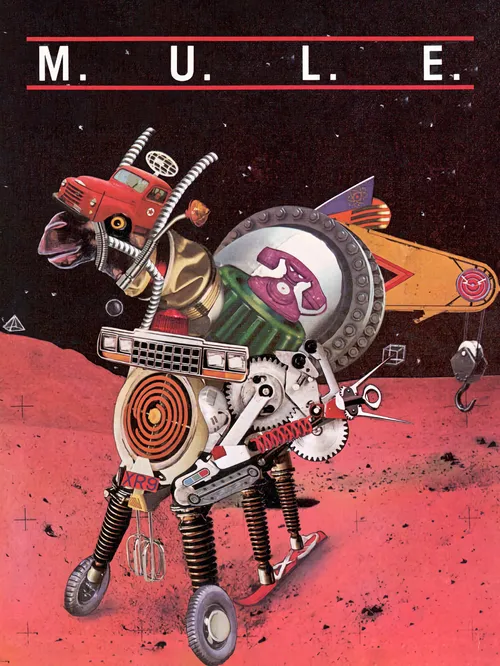
M.U.L.E. (1983) — four players at once, sharing a colony’s survival but not its profits — is still named by other designers among the best computer games ever made. Her best-seller, The Seven Cities of Gold (1984), was the single-player game she made only because her partners wouldn’t build the Civilization-like game she actually wanted; afterward, nearly everything she made was multiplayer, and several were commercial disasters ahead of their time. She built online real-time strategy in 1988 (Modem Wars) and four-player networked strategy in 1992.
She was credited as “Dan Bunten” on her work through 1992, and transitioned that year, taking her mother’s maiden name. In May 1998 she received the first Game Developers Conference Lifetime Achievement Award; she died of lung cancer two months later, at 49, while designing an internet M.U.L.E. Will Wright dedicated The Sims to her memory. The industry built her future without her, and mostly forgot whose it was.
Selected works
| 1978 | Wheeler Dealers | Design, programming, four-player controller |
| 1980 | Computer Quarterback | Design, programming |
| 1981 | Cartels & Cutthroatsin our catalogue | Original design, programming |
| 1982 | Cytron Masters | Design, programming |
| 1983 | M.U.L.E. | Design, programming |
| 1984 | The Seven Cities of Gold | Design, programming |
| 1985 | Heart of Africa | Design, programming |
| 1986 | Robot Rascals | Design |
| 1988 | Modem Wars | Design, programming |
| 1990 | Command H.Q. | Game design |
| 1992 | Global Conquest | Game design |
| 1997 | Warsport | Design |
Titles through 1992 were printed as “Dan Bunten”; her name is restored here. Several boxes credit her studio, Ozark Softscape, rather than any individual.
Sources: “The Designer’s Designer” — The Digital AntiquarianHalcyon Days interview (1997)The Strong — Dan Bunten (Dani Bunten Berry) papersWikipedia
In our catalogue
Play their work, preserved.