
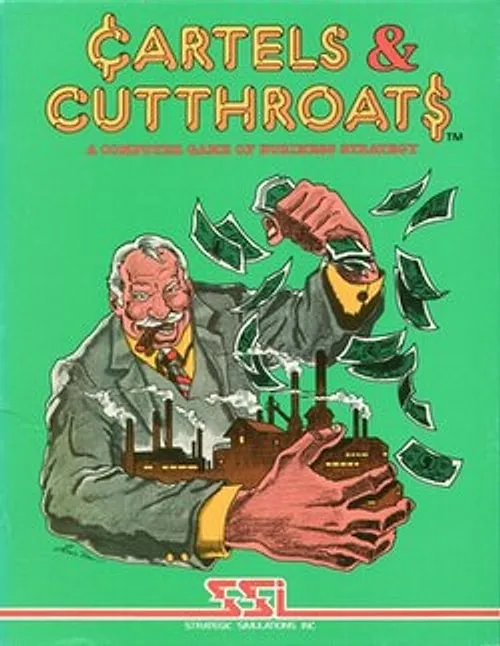
Cartels & Cutthroats
Run a company through the boom-and-bust cycles of an open market: set prices, manage production and inventory, borrow, advertise, invest in R&D, and out-maneuver up to seven rivals — human or computer. One of the earliest computer business simulations, and an early credit for the designer who would go on to define multiplayer gaming.
Play it
Choose your edition — from the real binary to a modern remake.
Original
The original binary itself, emulated in your browser — the game exactly as it shipped.

Faithful
The same game, loop for loop, rebuilt with a modern web interface we design — faithful underneath, comfortable to play today.

Revival
The Faithful game brought online — play live and simultaneously against others on the web, instead of passing one keyboard.

Successor
A full 2.0 — the original's premise carried forward into a brand-new, modern game of our own.
🔔 Get notified when the next edition lands
Drop your email and we'll tell you the moment the Faithful, online multiplayer, or Successor editions of Cartels & Cutthroats go live.
History
How it came to be.Cartels & Cutthroats was published by Strategic Simulations, Inc. (SSI) in 1981, during the first wave of serious home-computer strategy gaming. Where most of SSI's early catalog was wargames, C&C turned the same systems-modelling instinct toward economics: a complete simulation of running a company in a competitive market.
The game is an early credit for Danielle Bunten Berry (then credited as Dan Bunten), working with Bill Bunten. Bunten Berry would go on to design M.U.L.E. (1983) and The Seven Cities of Gold (1984) — landmark titles, with M.U.L.E. in particular celebrated for its pioneering simultaneous multiplayer. The fingerprints are already here in C&C: a focus on economic competition between players rather than combat.
Under the hood, the game is a network of interacting systems — a demand curve (price drives units sold, modulated by the wider economy and consumer tastes), a twelve-category cost structure, a macroeconomic layer of growth and interest-rate cycles, computer-controlled opponents, and a table of random market events. Players submit decisions each quarter and the simulation resolves the results.
It saw release across the popular platforms of the era, and is the title we used to prove out the studio’s preservation pipeline end-to-end: reading the original disk image, recovering the source, and validating a faithful re-creation against the real emulated binary.