
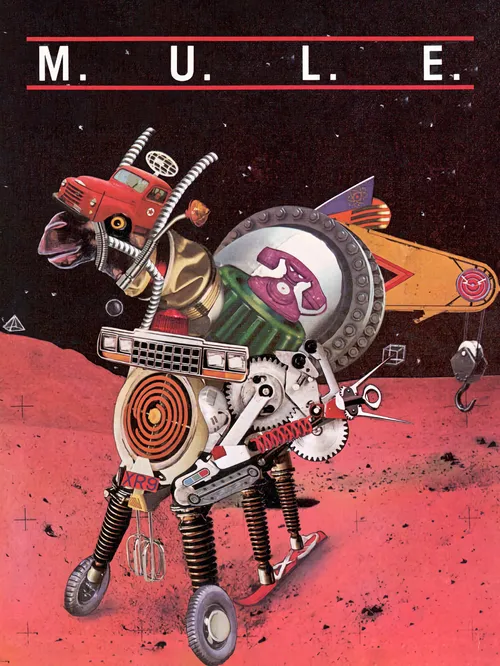
M.U.L.E.
Colonize the planet Irata with up to three rivals: stake plots, outfit a M.U.L.E. to produce food, energy, ore and the precious crystite, then haggle in a live open-market auction where the colony only survives if everyone produces, but the score is settled player against player. Four people acting at once: the game that taught the industry what multiplayer could be.
Play it
Choose your edition — from the real binary to a modern remake.
Original
The original binary itself, emulated in your browser — the game exactly as it shipped.

Faithful
The same game, loop for loop, rebuilt with a modern web interface we design — faithful underneath, comfortable to play today.

Revival
The Faithful game brought online — play live and simultaneously against others on the web, instead of passing one keyboard.

Successor
A full 2.0 — the original's premise carried forward into a brand-new, modern game of our own.
🔔 Get notified when the next edition lands
Drop your email and we'll tell you the moment the Faithful, online multiplayer, or Successor editions of M.U.L.E. go live.
History
How it came to be.M.U.L.E. was published by Electronic Arts in 1983, designed by Danielle Bunten Berry with her studio Ozark Softscape. It is routinely named by other designers among the best computer games ever made — a four-player game of economic competition and cooperation on the colony world of Irata (read it backwards). The colony’s survival is shared; the profit is not, and the game is remembered as much for the laughter and betrayal around the machine as for its elegant supply-and-demand economy.
It is the same designer’s follow-through on the idea already visible in Cartels & Cutthroats (1981): competition between players over an economy rather than combat. M.U.L.E. pushed it further — four players acting simultaneously, entering decisions by doing (you walk your mule out to the plot) rather than by menu — and its real-time auction is a direct descendant of the one in her earlier work. Will Wright later dedicated The Sims to Bunten Berry’s memory.
The edition we preserve here is the IBM PC (CGA) release, credited on its own boot screen as “Version 1.00 by K-BYTE,” running in your browser via the studio’s DOS emulation. M.U.L.E. first shipped on the Atari 8-bit — about the only mainstream machine of its day with four joystick ports — which is part of why simultaneous four-player play was so rare, and so celebrated.
Explore the full studio history →